
The Quality I Admire Most
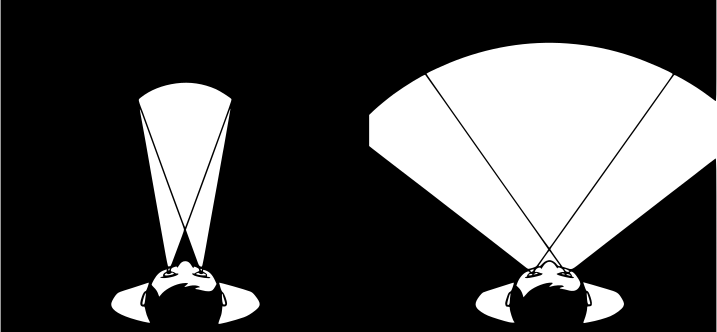
Many things separate a pauper from a king: material possessions, social connections, the fanciness of their dress. But these surface distinctions are remarkably mutable. Take the mud-slathered pauper, wash him clean, feed him off royal banquets, dress him in purple robes, oil his hair, and suddenly his appearance is indistinguishable from that of a king.
There is, however, an immutable mark on a man's spirit that is hard, if not impossible, to change: the way his mind's eye sees the world.
The allegorical pauper views things through the lens of scarcity. He will not invest because everything is fraught with risk and he would rather guard his little portion than stake it on something greater. Success, to him, is a zero-sum game, which is precisely why his neighbor's good fortune unsettles him. He perceives it as a quiet threat to his own share, not as proof that more is possible.
He suffers from an overwhelming preoccupation with the private matters of others, developing an unnecessary sensibility to them, which sometimes morphs into offence. The mental anguish he suffers over how other people live their lives would dissolve instantly if he simply looked away because the lives he fixates on are so remote from his own, and so genuinely inconsequential to his path.
He never bothers tracing the second and third-order consequences of his actions, the consequences of consequences. The slow chain reaction hidden in an apparently harmless choice made today. He cannot see how far a single decision travels. He is shortsighted and too impatient to cast his attention into the future.
He doesn't perceive and enjoy the absurdity of life. In his mind, things carry more weight than they should. I must be loved a certain way. I must have a job by 23. That guy shouldn't have spoken to me like that, I need to be respected. He uses a different tone with me, he must view me with contempt. Most of the rules and expectations governing social life are arbitrary, and one could simply decline to recognize their importance. There is tremendous freedom in that refusal – and he can't see it.
This impoverished way of seeing is sometimes society-wide. It takes the form of cheap pragmatism: judging actions purely by their immediate utility, dismissing anything that doesn't show quick returns as wasteful, impractical, a luxury reserved for the naive and those without real skin in the game. It is a grave and crippling perspective. Consider what would have been lost if Newton's curiosity about a falling apple had been waved off as idle fancy. We would have no satellites, no GPS, no google maps. If Faraday had not seen the latent value in playing with magnets and wires and rigorously documenting what he found, we would have no electricity in our homes. If Fleming had walked past his molds without pausing, there would be no penicillin. Cheap pragmatism tempts us to dismiss ideas before they have had the chance to become anything, to mistake the shoemaker's visible craft for something more valuable than the theorist's patient, invisible work.
The king, by contrast, finds beauty in the ordinary. The wind moving through grass. The birds at dawn. The chickens loose in the compound. The quiet dignity inside his own struggle. His outlook is global. He knows that things carry consequences beyond their surface.
Where was I? Yes — the pauper and the king. The caged, impoverished outlook versus the kingly mind which can access countless degrees of freedom.
That is the quality I find myself looking for, above all else, in the people I meet.